Category: Technology

  • How AI Is Replacing HVAC Answering Services in 2026

    For decades, the HVAC answering service was the standard solution to a simple problem: contractors can’t answer the phone when they’re on a job.

    You’d pay a monthly fee to a service staffed by human operators. Calls would come in, the operator would take a message, and you’d call the customer back when you could. It wasn’t perfect, but it was better than voicemail.

    In 2026, that model is being replaced. Not because the problem changed — contractors still can’t answer calls when they’re on jobs — but because the solution got dramatically better.
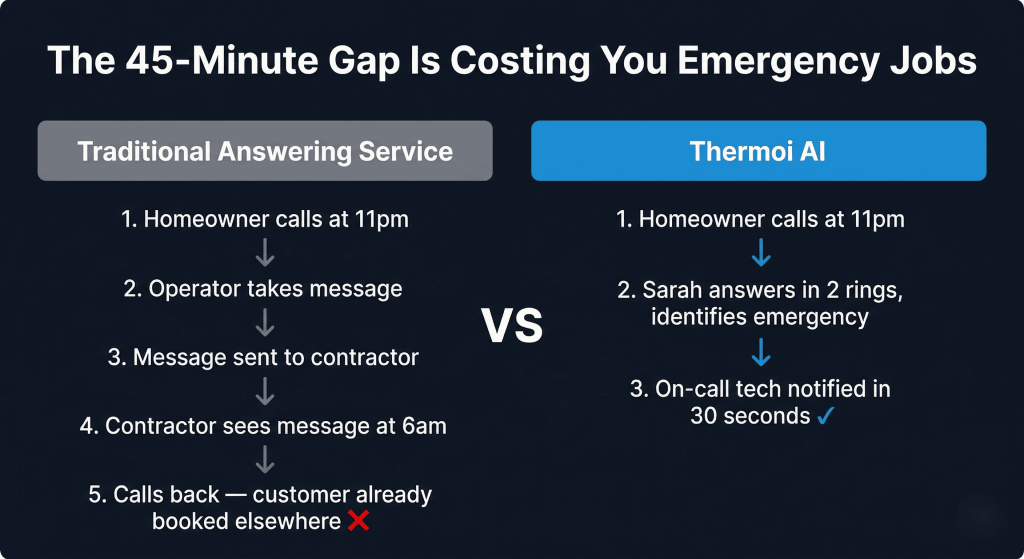
    AI phone system vs traditional HVAC answering service — speed and emergency response comparison

    This post explains what’s changing, why the traditional answering service is losing ground in HVAC specifically, and what the practical difference looks like for a small shop.

    What a traditional HVAC answering service actually does

    It’s worth being honest about what answering services deliver, because the gap between what contractors expect and what they get is part of why the shift is happening.

    A traditional answering service provides human operators who answer calls on your behalf, usually 24/7. The operator takes the caller’s name, phone number, and a brief description of why they called, then sends you a message — typically via SMS or email. You call the customer back.

    That’s the core service. Some answering services offer scheduling integration, but it’s basic — they can add an appointment to a shared calendar, but the operator typically doesn’t have visibility into your actual technician availability, job durations, or dispatch priorities.

    The pricing varies. Budget answering services charge $50–$150 per month for basic message-taking. More capable services with scheduling integration charge $200–$500 per month. Some charge per-minute or per-call rates on top of the base fee, which can add up significantly during peak season.

    For many HVAC contractors, this has been a reasonable spend for a long time. The question is whether it’s still the right spend in 2026.

    The three things traditional answering services can’t do

    1. Identify and respond to emergencies in real time.

    This is the biggest gap. When a homeowner calls at 11pm because their heat has stopped working in January, a traditional answering service operator takes a message. They might note “urgent” or “emergency” in the message. But they can’t notify your on-call tech directly. They can’t route the call differently. They take the information and send you a text, and you see it when you see it.

    For a routine booking, that delay is acceptable. For a genuine emergency, it’s not. In a competitive HVAC market, the contractor who notifies their on-call tech within seconds of an emergency call gets there first. The contractor who reviews messages in the morning finds out they lost the job the night before.

    AI phone systems like Thermoi handle this differently. When Sarah identifies emergency signals in a call — no heat, no AC, mentions of vulnerable household members, calls after 9pm during extreme weather — the on-call tech is notified immediately, automatically, with the caller’s address and a summary of the situation. No human relay required.

    2. Book appointments without calling back.

    Traditional answering services take messages. The callback is still on you. Every callback is a second interaction with a customer who has already waited, another chance for them to have found someone else, another task on a list that grows during busy periods.

    AI phone assistants book appointments during the first call. The homeowner calls, explains what they need, and gets a confirmed appointment time before they hang up. No callback. No waiting. The appointment appears in the dashboard immediately.

    For routine bookings especially — tune-ups, filter changes, seasonal maintenance checks — there’s no reason this process requires a human callback. The information needed to book an appointment (address, contact, availability, job type) can be collected and confirmed in a single call.

    3. Learn your business and improve over time.

    A traditional answering service operator reads from a script you provide when you sign up. They handle calls according to that script. If your procedures change, you update the script. If your service area changes, you notify the service. The system doesn’t adapt.

    AI phone systems are configured specifically for your business — your service area, your pricing, your emergency protocols, your on-call rotation schedule — and they produce data from every call. Full transcripts, appointment details, call patterns, and emergency flags all build up over time into operational intelligence you’ve never had before. Which call types are most common? What times do emergencies cluster? What questions do callers ask most often? That data exists now, accessible in a dashboard, and it improves how the system handles future calls.

    Why this shift is happening now

    The technology that makes AI phone assistants viable for HVAC didn’t exist five years ago. The combination of accurate speech recognition, natural language understanding capable of handling unscripted conversation, and low-latency voice synthesis has only become reliable enough for real business use in the past two to three years.

    The practical result is that an AI phone system can now conduct a conversation that most callers won’t immediately identify as automated — not because it’s trying to deceive them, but because the quality of the interaction is high enough that the distinction doesn’t register in the way it used to with old IVR systems.

    Callers who interacted with automated phone systems in 2018 learned to hate them. Press 1 for this, press 2 for that, please hold while we transfer your call. That experience trained a generation of people to distrust and resent phone automation.

    The AI systems operating in 2026 are categorically different. They answer naturally, ask follow-up questions, handle interruptions, and respond to the actual content of what the caller says rather than forcing them into a decision tree. The barrier to adoption — customer experience — has dropped significantly.

    What the economics look like

    A traditional answering service in the $200–$400/month range provides 24/7 human coverage with basic message-taking and limited scheduling.

    Thermoi costs $299/month and provides 24/7 AI coverage with real appointment booking, emergency dispatch notifications, full call transcripts, a dashboard showing every interaction, and Spanish-language capability.

    At similar price points, the AI option delivers more functionality. That’s the simple version of the economic case.

    The more important economics are on the revenue side. An answering service that takes messages reduces your missed call rate — callers reach a human instead of voicemail, which is meaningful. But if those calls still require a callback to convert to a booked appointment, you’re adding friction and delay into a process where your competitors may be answering and booking in a single call.

    The contractors who win on call conversion in 2026 will be the ones who complete the booking during the first call, identify emergencies in real time, and have operational data to show them where their call handling is strong and where it’s leaking revenue.

    What doesn’t change

    AI phone systems don’t change the fundamental relationship between an HVAC contractor and their customers. They handle the structured, informational part of call interactions — what do you need, when can we come, here’s your confirmation — so that the human interactions that matter (the technician at the door, the owner following up after a job, the conversation about a system replacement) can happen without the administrative overhead that currently consumes too much of everyone’s time.

    The on-call tech still goes to the job. The owner still makes the decisions about pricing and staffing. The relationship with the customer is still built through the quality of the work. What changes is the layer around all of that — the calls that come in at 10pm, the routine bookings that happen at noon on a Tuesday, the Spanish-speaking caller who needs to schedule a maintenance visit.

    Those interactions get handled immediately, accurately, and at any hour. Everything else stays the same.

    The transition

    Moving from a traditional answering service to an AI phone assistant doesn’t require a long implementation. Thermoi’s setup involves configuring Sarah with your business information — service area, on-call protocols, emergency procedures, scheduling preferences — and typically takes a day or two before the system is live.

    The $50 two-week pilot is the lowest-risk way to see the difference in practice. Run both systems in parallel if you want — keep your answering service active and see how Sarah handles calls alongside it. After two weeks you’ll have data: how many calls came in, what types they were, how many appointments were booked, how many emergencies were flagged.

    That data will tell you more than any comparison article can.
  • HVAC Appointment Scheduling Software: What Contractors Actually Need in 2026

    If you’ve searched for HVAC appointment scheduling software recently, you’ve probably found two things: enterprise platforms that cost $300–$500 per seat per month and are built for companies with 50+ technicians, and generic scheduling tools that work fine for a yoga studio but have no idea what an emergency dispatch workflow looks like.

    Neither of those solves the actual problem most HVAC contractors have.

    This post breaks down what scheduling software actually needs to do for an HVAC business, what the real options are in 2026, and where AI fits into the picture.

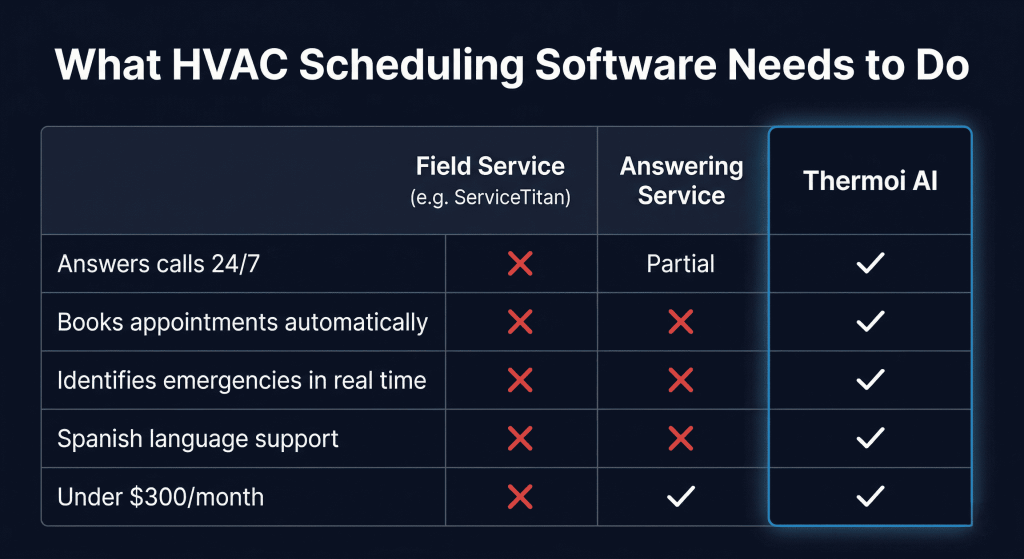
    HVAC scheduling software comparison — ServiceTitan vs Housecall Pro vs Thermoi AI

    What makes HVAC scheduling different from other industries

    Scheduling for HVAC isn’t just putting appointments on a calendar. It involves a set of constraints and scenarios that generic scheduling tools weren’t designed for.

    Emergency vs. routine calls need completely different workflows. A homeowner booking a spring AC tune-up can be scheduled three weeks out with a standard calendar slot. A homeowner whose heat has stopped working in January cannot wait three weeks — or three hours. Any scheduling system for HVAC needs to handle both scenarios, and handle them differently. The emergency caller needs immediate notification to an on-call tech. The routine caller needs a convenient slot in the next available window.

    After-hours is when it matters most. HVAC emergencies don’t wait for business hours. The highest-value calls — system failures, no heat, no AC during extreme weather — come in disproportionately in the evenings, on weekends, and during weather events. A scheduling system that only works when someone is in the office is only solving half the problem.

    Multiple job types need different time allocations. A diagnostic visit might take one hour. An AC system replacement might take six. A routine maintenance check might take 45 minutes. Unlike a business that schedules identical appointments, HVAC contractors need scheduling logic that accounts for job type, travel time between jobs, and technician skill level.

    The person booking isn’t always the decision maker. Tenants call for rental properties. Office managers call for commercial accounts. Spouses call for each other. The scheduling system needs to capture the right contact and site information without assuming every caller is the property owner.

    The three categories of scheduling software HVAC contractors use

    1. Field service management platforms (ServiceTitan, Housecall Pro, Jobber)

    These are the comprehensive, all-in-one platforms built specifically for trades businesses. They handle scheduling, dispatch, invoicing, payments, customer history, and reporting in a single system.

    ServiceTitan is the market leader — used by large HVAC companies and officially partnered with major brands like Carrier and Lennox. It’s genuinely powerful. It’s also priced for larger operations, typically running $125–$400 per user per month with significant onboarding costs. For a 1–5 tech shop that needs scheduling software, it’s often overkill and the learning curve is steep.

    Housecall Pro and Jobber are more accessible — priced at $49–$249 per month depending on the plan — and are genuinely good tools for small and mid-size HVAC shops that want scheduling, invoicing, and basic dispatch in one place. If you’re currently managing jobs on a whiteboard or in Google Sheets, either of these is a significant upgrade.

    The limitation: all of these platforms assume someone is present to receive the call, book the appointment, and enter it into the system. They solve dispatch and job management well. They don’t solve what happens when nobody picks up the phone.

    2. General scheduling tools (Calendly, Cal.com, Acuity)

    These are simple online booking tools that let customers self-schedule appointments from a calendar link. They work well for businesses with predictable, identical appointment types — consultants, therapists, tutors.

    For HVAC, they’re a partial solution at best. A homeowner with a broken AC at 9pm doesn’t want to visit a booking page and pick a time slot. They want to talk to someone. Self-scheduling tools also can’t identify emergencies, capture technical details about equipment, or adjust available times based on technician location and job load.

    Some HVAC contractors use Calendly as a demo booking tool or for non-urgent maintenance requests, which is a reasonable use case. For primary call handling, it’s not the right tool.

    3. AI phone assistants with built-in scheduling

    This is the newest category and the one most directly addressing the gap the other two leave open — after-hours call handling with immediate appointment booking.

    An AI phone assistant answers every inbound call regardless of the time, conducts a real conversation to understand what the caller needs, identifies emergencies vs. routine requests, and either books the appointment directly or notifies the on-call tech immediately. The appointment appears in the contractor’s dashboard without anyone having to manually enter it.

    Thermoi’s Sarah does this on every call. A homeowner calls at 10pm, Sarah answers within two rings, identifies whether it’s an emergency or a booking request, captures the address and equipment details, and books the appointment or fires the on-call notification. The contractor wakes up with a full log of every call that came in overnight, with transcripts and booked appointments already in the dashboard.

    The distinction from field service management platforms is that AI phone assistants solve the front-door problem — what happens when the call comes in — rather than the back-office problem of managing jobs once they’re booked. The two aren’t mutually exclusive: many contractors will eventually use both.

    What to look for in HVAC scheduling software specifically

    Whether you’re evaluating a full field service platform or an AI call handling system, these are the capabilities that matter for HVAC specifically:

    Emergency identification and routing. The system needs to distinguish a no-heat emergency from a routine booking request, and respond differently to each. If it can’t make that distinction, it’s not designed for HVAC.

    After-hours capability. Any gap in coverage is a gap in revenue. The system should handle calls and booking at 2am with the same reliability as 10am.

    Calendar integration. Booked appointments should appear in whatever calendar or dispatch system you already use — Google Calendar, iCal, or a field service platform — without manual data entry.

    Call records and transcripts. Every interaction should produce a written record. This matters for quality control, dispute resolution, and understanding your call patterns over time.

    Spanish-language support. In Phoenix and across the southwest, a significant portion of homeowner calls come in Spanish. A scheduling system that can’t serve those callers is leaving business on the table.

    Realistic pricing for small shops. A 2-tech HVAC operation doesn’t need enterprise software at $300/seat/month. The sweet spot for small shops is $50–$300/month for software that solves a specific problem well.

    The gap most HVAC scheduling software doesn’t address

    Here’s the honest summary of where the market stands in 2026: the field service platforms (ServiceTitan, Housecall Pro, Jobber) are excellent at managing jobs that are already in the system. They’re not designed to handle the moment when a call comes in and nobody is available to answer it.

    That gap — after-hours calls, busy-period overflow, the Friday night emergency — is where HVAC businesses lose the most revenue. It’s also where AI phone assistants are specifically designed to help.

    The right setup for most small HVAC shops isn’t one tool that does everything. It’s a combination: a lightweight field service tool for job management and invoicing, and an AI phone assistant to make sure every call that comes in gets answered and booked, regardless of the time.

    For contractors not yet using any scheduling software — still managing jobs on a whiteboard or personal cell — the highest-ROI starting point is almost always solving the missed call problem first. A booked appointment you never knew about is worth nothing. A call answered and booked automatically at 11pm on a Saturday is worth $400–$700 before you even wake up.

    Thermoi’s approach

    Thermoi focuses specifically on the call handling and appointment booking layer — the front door of your HVAC operation. Sarah answers every call 24/7, identifies emergencies, books routine appointments automatically, and notifies your on-call tech immediately when something can’t wait until morning.

    The pilot is $50 for two weeks. Most contractors see the first after-hours booking within the first few days.

  • The Complete Guide to AI Phone Systems for HVAC Contractors


    If you run an HVAC business, you’ve probably noticed more tools showing up that promise to “use AI” to fix your operations. Some of them are genuinely useful. A lot of them aren’t built for the way HVAC businesses actually work.

    This guide covers what AI phone systems are, how they work in the context of an HVAC business specifically, what to look for when evaluating one, and where the real ROI comes from. No hype — just a practical breakdown from the contractor’s perspective.

    What an AI phone system actually is

    An AI phone system is software that answers inbound calls on your behalf, conducts a real conversation with the caller, and takes a defined action at the end — booking an appointment, flagging an emergency, sending a transcript, or routing to a human.

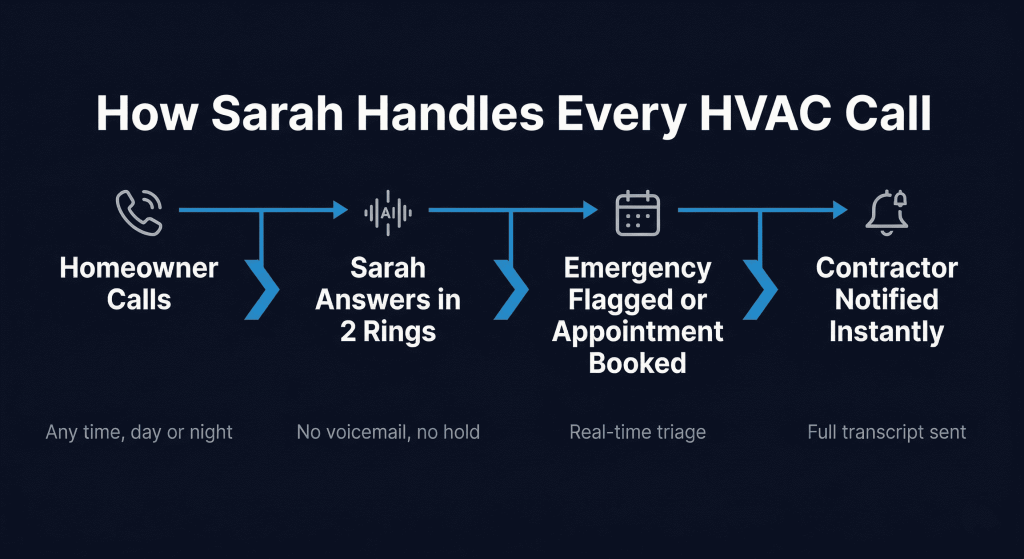
    How an AI phone system works for HVAC contractors — Sarah handles inbound calls 24/7

    It’s not a voicemail system. It’s not a pre-recorded message tree. When a homeowner calls and says “my AC just stopped working and it’s 95 degrees in here,” a well-built AI phone system understands that sentence, recognises the urgency, asks the right follow-up questions, and responds appropriately — either booking an emergency appointment or notifying your on-call tech immediately.

    The underlying technology is voice AI — the same category of technology powering tools like Siri, Alexa, and more recently, a generation of purpose-built business phone assistants. What makes modern voice AI meaningfully better than older systems is that it handles natural, unscripted conversation. Callers don’t have to press 1 for this and 2 for that. They just talk.

    Why HVAC is a particularly good fit for AI phone systems

    Not every business benefits equally from AI phone systems. HVAC does, for several specific reasons.

    Call timing is unpredictable and urgent. Unlike a dentist’s office where appointments are scheduled weeks in advance, HVAC emergencies happen without warning — and they happen disproportionately at inconvenient times. A heat pump failure in January doesn’t wait for business hours. An AC breakdown in a Phoenix summer hits at 7pm on a Friday. These are the calls most likely to hit voicemail, and they’re the calls with the highest urgency and highest job value.

    The first-to-answer wins. When a homeowner’s HVAC system fails, they don’t send one enquiry and wait. They call three contractors in a row and book with whoever picks up. The competitive dynamic in HVAC is immediate and winner-takes-all on each call. A contractor who answers 90% of calls captures jobs that their competitors never even know they lost.

    There’s a clear, measurable ROI. A typical HVAC service call runs $200–$700. A system replacement is $5,000–$15,000. If an AI phone system captures two additional calls per week that would otherwise have gone to voicemail, the ROI is obvious and calculable — usually well under two months to break even at $299/month.

    Emergency and routine calls need different handling. This is the nuance that generic AI call systems miss. A homeowner asking about a spring tune-up can wait until morning. A homeowner with no AC and a baby in the house cannot. HVAC specifically requires a system that can distinguish between these two scenarios and respond differently — routing emergencies to the on-call tech immediately rather than adding them to tomorrow’s queue.

    How an AI phone system works on a real HVAC call

    Here’s what happens on a typical inbound call handled by Thermoi’s AI assistant, Sarah.

    A homeowner calls at 9:47pm. Their upstairs AC unit stopped blowing cold air three hours ago. Sarah answers within two rings. She introduces herself as calling on behalf of the HVAC company, asks what the issue is, and listens. The homeowner explains the problem. Sarah asks a few follow-up questions — how long it’s been down, whether it’s making any unusual sounds, whether anyone in the house has medical needs that make heat particularly dangerous.

    Based on those answers, Sarah determines this is an urgent situation. She doesn’t offer a next-day appointment. She tells the homeowner that she’s going to notify the on-call technician immediately and that someone will be in touch within the hour. She captures the address, confirms the contact number, and sends a full transcript to the contractor’s dashboard.

    The on-call tech gets an SMS notification within 30 seconds. The contractor’s dashboard shows the full call record with the AI’s summary of the situation.

    That’s one call that would have hit voicemail without a system like this. Depending on the urgency, that’s a $300–$500 service call or the beginning of a system replacement conversation.

    What to look for when evaluating an AI phone system for HVAC

    Not all AI phone systems are built the same. Here’s what matters specifically for HVAC:

    Emergency detection. The system needs to identify emergency signals in real conversation — “no heat,” “no AC,” mentions of vulnerable household members, late-night calls during extreme weather — and handle those calls differently from routine ones. If the system treats every call the same way, it’s not designed for HVAC.

    Natural conversation handling. Homeowners don’t speak in structured sentences. They ramble, backtrack, and describe problems in non-technical terms. The AI needs to extract the relevant information without making them feel like they’re filling in a form. If the system requires callers to respond in specific phrases, it will frustrate people and hurt your reputation.

    Appointment booking integration. Capturing information is only half the job. The system should book the appointment directly into your calendar — not just send you a message saying someone called. Thermoi’s Sarah books appointments that appear immediately in the dashboard, complete with customer details and the AI’s summary of the call.

    Full call transcripts. Every call should produce a written record. This matters for two reasons: first, you can review any call where something went wrong and understand exactly what happened. Second, the transcript data builds up over time into a picture of your most common call types, objections, and customer pain points.

    Bilingual capability. In Phoenix and across much of the US southwest, Spanish-speaking callers represent a significant portion of the market. An AI system that can handle Spanish-language calls without switching to a different mode or failing mid-conversation is a meaningful advantage.

    White-label capability. The best systems answer as your company, not as a generic AI service. When Sarah answers a call for Smith’s Heating and Cooling, she introduces herself as being with Smith’s Heating and Cooling. Callers don’t know they’re talking to an AI unless they ask.

    What AI phone systems don’t do (yet)

    Being clear about limitations matters.

    Current AI phone systems are designed for inbound call handling — answering calls, gathering information, booking appointments, and routing emergencies. They’re not yet capable of handling complex diagnostic conversations (a homeowner trying to troubleshoot a problem live), nuanced negotiation (a customer pushing back hard on pricing), or situations that require genuine human judgment about ambiguous circumstances.

    The right way to think about them is as a highly capable first point of contact. They handle the structured part of the call — capturing information, qualifying urgency, booking the appointment — and hand off anything that needs a human to a human.

    For most HVAC contractors, this covers 80–90% of inbound calls entirely, and gives the remaining 10–20% a much better first experience than voicemail.

    The setup process

    One of the common objections to AI phone systems is complexity — contractors assume integration will take weeks and require an IT person.

    For Thermoi, the setup process is straightforward. You provide your business information, emergency dispatch preferences, and on-call schedule. Sarah is configured to represent your company specifically — your name, your service area, your procedures for handling emergencies versus routine bookings. Most contractors are live within a day or two.

    The two-week pilot at $50 is designed to let you see the system working on real calls before committing to the full $299/month. If Sarah handles even two calls during the pilot that would otherwise have gone to voicemail, the pilot pays for itself.

    The question worth asking yourself

    Before spending more on ads, hiring a part-time receptionist, or upgrading your answering service, it’s worth asking a simpler question: what percentage of calls that come into your business right now are actually being answered?

    If the honest answer is anything below 85–90% — accounting for evenings, weekends, busy periods when all your techs are on jobs — then an AI phone system is the highest-ROI investment available to you. It doesn’t generate new leads. It captures the leads you’re already paying for but currently losing.

    That’s the real value of a voice AI for HVAC. Not magic. Just never missing a call again.