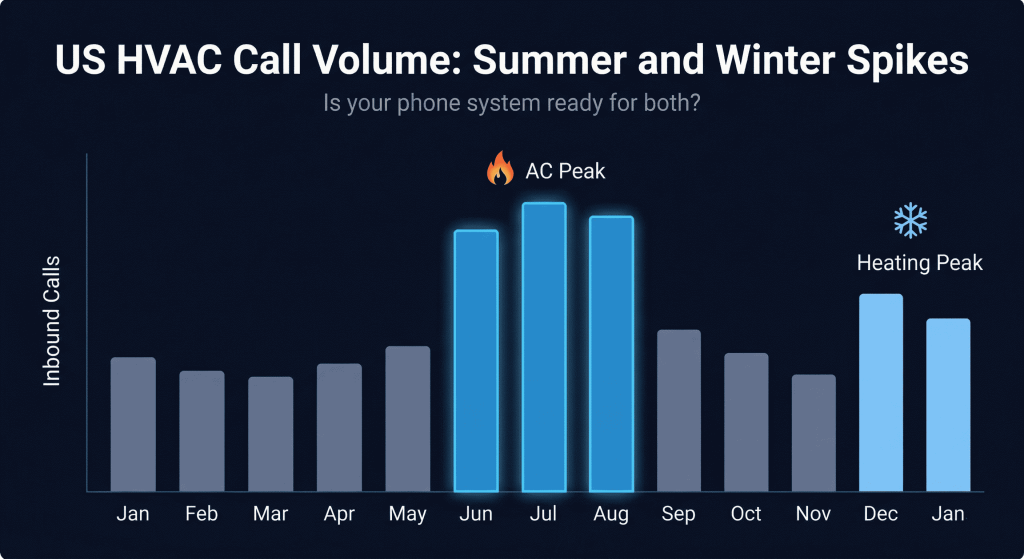
There’s a decision that happens inside every HVAC call handling system — human or AI — that most contractors have never explicitly thought about.
When a call comes in at 8pm and someone says their air conditioning isn’t working, what happens next?
Option A: The system books them into the next available appointment slot — tomorrow morning at 9am.
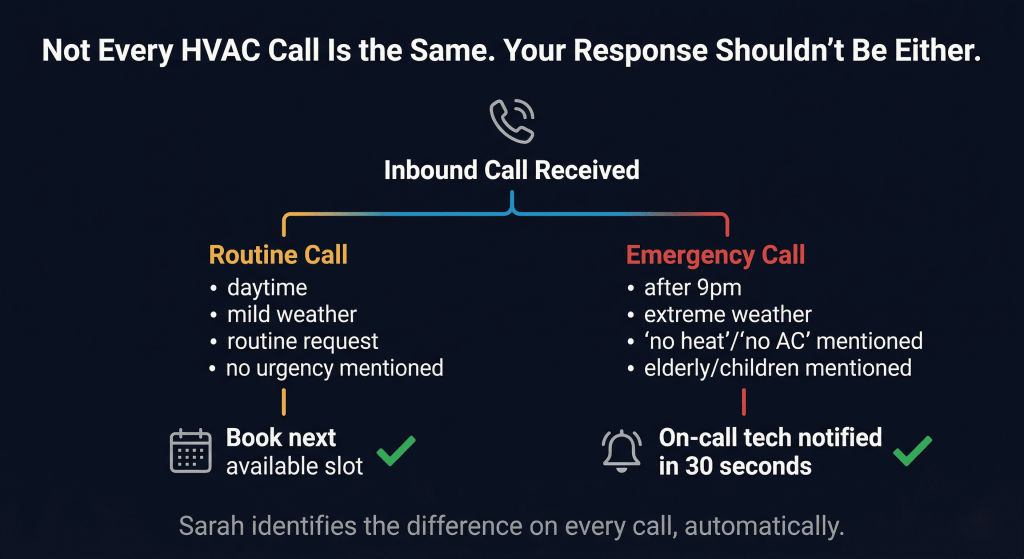
Option B: The system identifies this as an urgent situation, notifies the on-call technician immediately, and tells the homeowner that someone will be in touch within the hour.
Most generic call handling systems — answering services, basic AI phone tools, voicemail — default to Option A for every call. It’s simpler. It requires no judgment. It fills the calendar.
The problem is that Option A is the wrong answer for a meaningful percentage of calls. And getting it wrong costs you the job.
The two types of HVAC calls and why they require different responses
Not every HVAC call is urgent. Understanding the distinction — and handling each type correctly — is the difference between a system that serves your customers well and one that frustrates them.
Routine calls are requests where timing is flexible. A homeowner wants to book their annual AC tune-up before summer. Someone needs a filter replacement. A landlord is scheduling a pre-winter heating inspection. These calls can be handled with standard appointment booking. The caller is not in distress. They have flexibility. The goal is to get them on the calendar efficiently.
Emergency calls are requests where timing is not flexible. A family’s heating has failed on a cold night. An AC unit has stopped working entirely during a heatwave. An elderly homeowner is calling because their house is getting dangerously warm. These callers are not looking to schedule an appointment. They are looking for reassurance that help is coming — now.
The mistake most call handling systems make is treating both types identically. They collect the caller’s information and add them to the appointment queue. For a routine call, that’s exactly right. For an emergency call, it’s a failure that sends the customer to your competitor before they’ve even hung up.
What emergency callers actually need to hear
When a homeowner calls in a genuine HVAC emergency, their emotional state is somewhere between stressed and panicking. They’re not thinking about pricing. They’re not comparing contractors. They’re thinking about their family’s comfort and whether they can get help tonight.
What they need to hear in the first 60 seconds is simple:
They need to know someone is coming. Not “we’ll call you back in the morning.” Not “our next available appointment is Thursday.” They need to hear that an on-call technician has been notified and will be in touch shortly with an arrival time.
That single piece of information — someone is coming — changes everything about the interaction. The homeowner relaxes. They stay on the line. They don’t immediately call the next contractor. And when the technician arrives, the customer is already grateful before the job has even started.
Getting this wrong has the opposite effect. A homeowner who calls in a genuine emergency and gets offered a next-morning appointment will feel abandoned. They will call the next contractor immediately. And they will never call you again — not because you did bad work, but because when they needed you, you weren’t there.
The signals that identify an emergency call
A well-designed call handling system — whether human or AI — identifies emergency situations in real time using a combination of signals from the call itself.
The explicit statement. Callers often say it directly: “my AC completely stopped working,” “we have no heat,” “the furnace just died.” These are unambiguous emergency signals that should immediately shift the call handling protocol.
The timing. A call coming in at 9pm or later, particularly during extreme weather, is far more likely to be an emergency than a call at 10am on a Tuesday. After-hours calls warrant a higher default level of urgency.
The weather context. A “my AC isn’t cooling as well as it used to” call during a mild spring day is a routine booking. The same call during a Phoenix July heatwave with temperatures above 105°F is potentially urgent — the system’s performance may be masking an impending failure. Context matters.
Vulnerability mentions. When a caller mentions elderly family members, young children, or medical conditions that make heat or cold particularly dangerous, the call is an emergency regardless of how the equipment failure is described. “My mother is 82 and her heat isn’t working” is an emergency. Treat it as one.
Repeat callbacks. A caller who has already called once and not received a response is escalating urgency with every repeated attempt. This signal is easy to miss with basic call handling but matters a great deal.
Thermoi’s Sarah listens for all of these signals in real time during every inbound call. When emergency indicators are present, the call handling protocol shifts automatically — rather than booking a next-day slot, she notifies the on-call tech immediately and gives the homeowner an honest, reassuring response about what happens next.
Why “just book everything next-day” is expensive
The temptation to simplify call handling by treating every call as a routine booking request is understandable. It’s consistent. It’s easy to manage. It fills the calendar in an orderly way.
The cost shows up in a few different places.
First, you lose the emergency jobs to competitors who answer and dispatch correctly. These are typically your highest-value calls — emergency pricing, high urgency to get the job done, and grateful customers who remember how you showed up when they needed you.
Second, you damage your reputation with the callers you let down. Online reviews increasingly mention after-hours responsiveness as a deciding factor. “Called at 10pm, they came within an hour” is a five-star review. “Told me to call back in the morning when my heat was out” is a one-star review. Both outcomes come from the same call handling decision.
Third, you miss the relationship opportunity. An HVAC contractor who handles a homeowner’s emergency correctly — fast response, professional technician, problem solved — typically earns that customer’s loyalty for years. Annual maintenance plans, future equipment replacements, and referrals all flow from that first emergency well handled. None of that happens if they book with your competitor instead.
Building a system that makes the right call every time
The practical challenge for small HVAC shops is that making this distinction correctly — every time, at any hour — requires either a very well-trained human available 24/7 or a system designed to make the distinction automatically.
Traditional answering services generally can’t do this. They take messages. They might note “urgent” or “emergency” in the message body. But they don’t change their protocol based on the signals in the call, and they don’t notify your on-call tech directly in real time.
AI phone assistants built specifically for HVAC — like Thermoi — are designed to make this distinction as a core function. It’s not an optional feature. It’s the fundamental difference between a call handling tool and a genuine operational upgrade.
When Sarah takes an inbound call, the first thing she’s doing — before booking, before capturing details — is assessing urgency. Routine calls go into the appointment queue. Emergency calls trigger immediate on-call notification with the caller’s address and a summary of the situation. The on-call tech knows within 30 seconds. The homeowner knows someone is coming.
That’s what customers actually want when they call in a genuine emergency. And it’s what separates the contractors who win those jobs from the ones who find out the next morning that they missed them.
The practical implementation
For contractors currently handling after-hours calls through voicemail or a basic answering service, the transition to a system that makes this distinction correctly doesn’t require rebuilding your entire operation.
It requires two things: a call handling layer that correctly identifies emergencies in real time, and an on-call protocol that’s fast enough to be meaningful. If your on-call tech gets notified within 30 seconds of a call but doesn’t respond for 90 minutes, the notification speed advantage is lost. Both parts of the chain matter.
Thermoi’s two-week pilot at $50 gives you a direct look at how this works in practice on your real inbound calls. You’ll see every call logged, every emergency flag triggered, every on-call notification sent. After two weeks you’ll have a clear picture of how many emergency calls you’ve been handling correctly — and how many have been slipping through as routine bookings.