Blog

  • Emergency Dispatch vs Next-Day Scheduling: What HVAC Customers Actually Want

    There’s a decision that happens inside every HVAC call handling system — human or AI — that most contractors have never explicitly thought about.

    When a call comes in at 8pm and someone says their air conditioning isn’t working, what happens next?

    Option A: The system books them into the next available appointment slot — tomorrow morning at 9am.
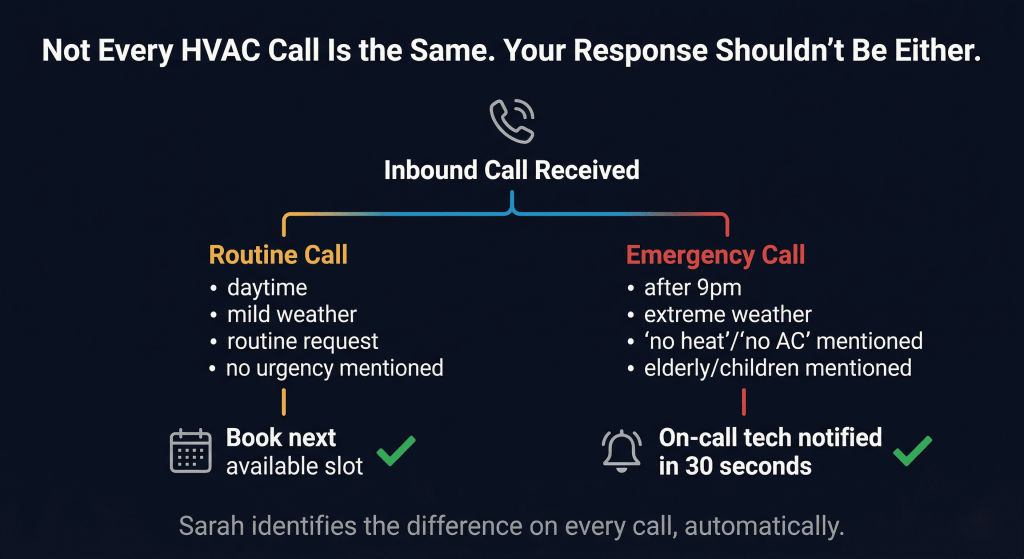
    HVAC emergency dispatch vs routine scheduling — how to identify urgent calls in real time

    Option B: The system identifies this as an urgent situation, notifies the on-call technician immediately, and tells the homeowner that someone will be in touch within the hour.

    Most generic call handling systems — answering services, basic AI phone tools, voicemail — default to Option A for every call. It’s simpler. It requires no judgment. It fills the calendar.

    The problem is that Option A is the wrong answer for a meaningful percentage of calls. And getting it wrong costs you the job.

    The two types of HVAC calls and why they require different responses

    Not every HVAC call is urgent. Understanding the distinction — and handling each type correctly — is the difference between a system that serves your customers well and one that frustrates them.

    Routine calls are requests where timing is flexible. A homeowner wants to book their annual AC tune-up before summer. Someone needs a filter replacement. A landlord is scheduling a pre-winter heating inspection. These calls can be handled with standard appointment booking. The caller is not in distress. They have flexibility. The goal is to get them on the calendar efficiently.

    Emergency calls are requests where timing is not flexible. A family’s heating has failed on a cold night. An AC unit has stopped working entirely during a heatwave. An elderly homeowner is calling because their house is getting dangerously warm. These callers are not looking to schedule an appointment. They are looking for reassurance that help is coming — now.

    The mistake most call handling systems make is treating both types identically. They collect the caller’s information and add them to the appointment queue. For a routine call, that’s exactly right. For an emergency call, it’s a failure that sends the customer to your competitor before they’ve even hung up.

    What emergency callers actually need to hear

    When a homeowner calls in a genuine HVAC emergency, their emotional state is somewhere between stressed and panicking. They’re not thinking about pricing. They’re not comparing contractors. They’re thinking about their family’s comfort and whether they can get help tonight.

    What they need to hear in the first 60 seconds is simple:

    They need to know someone is coming. Not “we’ll call you back in the morning.” Not “our next available appointment is Thursday.” They need to hear that an on-call technician has been notified and will be in touch shortly with an arrival time.

    That single piece of information — someone is coming — changes everything about the interaction. The homeowner relaxes. They stay on the line. They don’t immediately call the next contractor. And when the technician arrives, the customer is already grateful before the job has even started.

    Getting this wrong has the opposite effect. A homeowner who calls in a genuine emergency and gets offered a next-morning appointment will feel abandoned. They will call the next contractor immediately. And they will never call you again — not because you did bad work, but because when they needed you, you weren’t there.

    The signals that identify an emergency call

    A well-designed call handling system — whether human or AI — identifies emergency situations in real time using a combination of signals from the call itself.

    The explicit statement. Callers often say it directly: “my AC completely stopped working,” “we have no heat,” “the furnace just died.” These are unambiguous emergency signals that should immediately shift the call handling protocol.

    The timing. A call coming in at 9pm or later, particularly during extreme weather, is far more likely to be an emergency than a call at 10am on a Tuesday. After-hours calls warrant a higher default level of urgency.

    The weather context. A “my AC isn’t cooling as well as it used to” call during a mild spring day is a routine booking. The same call during a Phoenix July heatwave with temperatures above 105°F is potentially urgent — the system’s performance may be masking an impending failure. Context matters.

    Vulnerability mentions. When a caller mentions elderly family members, young children, or medical conditions that make heat or cold particularly dangerous, the call is an emergency regardless of how the equipment failure is described. “My mother is 82 and her heat isn’t working” is an emergency. Treat it as one.

    Repeat callbacks. A caller who has already called once and not received a response is escalating urgency with every repeated attempt. This signal is easy to miss with basic call handling but matters a great deal.

    Thermoi’s Sarah listens for all of these signals in real time during every inbound call. When emergency indicators are present, the call handling protocol shifts automatically — rather than booking a next-day slot, she notifies the on-call tech immediately and gives the homeowner an honest, reassuring response about what happens next.

    Why “just book everything next-day” is expensive

    The temptation to simplify call handling by treating every call as a routine booking request is understandable. It’s consistent. It’s easy to manage. It fills the calendar in an orderly way.

    The cost shows up in a few different places.

    First, you lose the emergency jobs to competitors who answer and dispatch correctly. These are typically your highest-value calls — emergency pricing, high urgency to get the job done, and grateful customers who remember how you showed up when they needed you.

    Second, you damage your reputation with the callers you let down. Online reviews increasingly mention after-hours responsiveness as a deciding factor. “Called at 10pm, they came within an hour” is a five-star review. “Told me to call back in the morning when my heat was out” is a one-star review. Both outcomes come from the same call handling decision.

    Third, you miss the relationship opportunity. An HVAC contractor who handles a homeowner’s emergency correctly — fast response, professional technician, problem solved — typically earns that customer’s loyalty for years. Annual maintenance plans, future equipment replacements, and referrals all flow from that first emergency well handled. None of that happens if they book with your competitor instead.

    Building a system that makes the right call every time

    The practical challenge for small HVAC shops is that making this distinction correctly — every time, at any hour — requires either a very well-trained human available 24/7 or a system designed to make the distinction automatically.

    Traditional answering services generally can’t do this. They take messages. They might note “urgent” or “emergency” in the message body. But they don’t change their protocol based on the signals in the call, and they don’t notify your on-call tech directly in real time.

    AI phone assistants built specifically for HVAC — like Thermoi — are designed to make this distinction as a core function. It’s not an optional feature. It’s the fundamental difference between a call handling tool and a genuine operational upgrade.

    When Sarah takes an inbound call, the first thing she’s doing — before booking, before capturing details — is assessing urgency. Routine calls go into the appointment queue. Emergency calls trigger immediate on-call notification with the caller’s address and a summary of the situation. The on-call tech knows within 30 seconds. The homeowner knows someone is coming.

    That’s what customers actually want when they call in a genuine emergency. And it’s what separates the contractors who win those jobs from the ones who find out the next morning that they missed them.

    The practical implementation

    For contractors currently handling after-hours calls through voicemail or a basic answering service, the transition to a system that makes this distinction correctly doesn’t require rebuilding your entire operation.

    It requires two things: a call handling layer that correctly identifies emergencies in real time, and an on-call protocol that’s fast enough to be meaningful. If your on-call tech gets notified within 30 seconds of a call but doesn’t respond for 90 minutes, the notification speed advantage is lost. Both parts of the chain matter.

    Thermoi’s two-week pilot at $50 gives you a direct look at how this works in practice on your real inbound calls. You’ll see every call logged, every emergency flag triggered, every on-call notification sent. After two weeks you’ll have a clear picture of how many emergency calls you’ve been handling correctly — and how many have been slipping through as routine bookings.
  • How AI Is Replacing HVAC Answering Services in 2026

    For decades, the HVAC answering service was the standard solution to a simple problem: contractors can’t answer the phone when they’re on a job.

    You’d pay a monthly fee to a service staffed by human operators. Calls would come in, the operator would take a message, and you’d call the customer back when you could. It wasn’t perfect, but it was better than voicemail.

    In 2026, that model is being replaced. Not because the problem changed — contractors still can’t answer calls when they’re on jobs — but because the solution got dramatically better.

    AI phone system vs traditional HVAC answering service — speed and emergency response comparison

    This post explains what’s changing, why the traditional answering service is losing ground in HVAC specifically, and what the practical difference looks like for a small shop.

    What a traditional HVAC answering service actually does

    It’s worth being honest about what answering services deliver, because the gap between what contractors expect and what they get is part of why the shift is happening.

    A traditional answering service provides human operators who answer calls on your behalf, usually 24/7. The operator takes the caller’s name, phone number, and a brief description of why they called, then sends you a message — typically via SMS or email. You call the customer back.

    That’s the core service. Some answering services offer scheduling integration, but it’s basic — they can add an appointment to a shared calendar, but the operator typically doesn’t have visibility into your actual technician availability, job durations, or dispatch priorities.

    The pricing varies. Budget answering services charge $50–$150 per month for basic message-taking. More capable services with scheduling integration charge $200–$500 per month. Some charge per-minute or per-call rates on top of the base fee, which can add up significantly during peak season.

    For many HVAC contractors, this has been a reasonable spend for a long time. The question is whether it’s still the right spend in 2026.

    The three things traditional answering services can’t do

    1. Identify and respond to emergencies in real time.

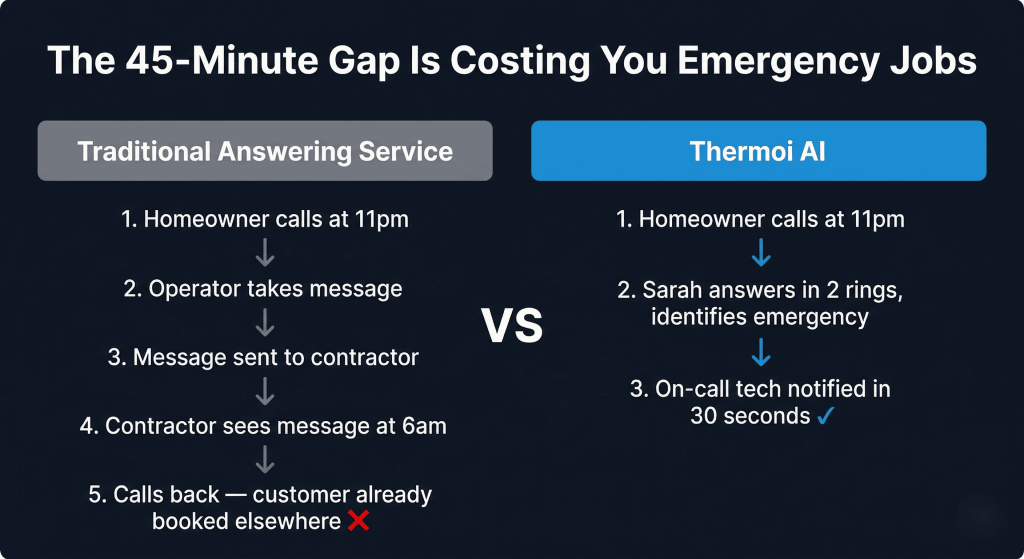
    This is the biggest gap. When a homeowner calls at 11pm because their heat has stopped working in January, a traditional answering service operator takes a message. They might note “urgent” or “emergency” in the message. But they can’t notify your on-call tech directly. They can’t route the call differently. They take the information and send you a text, and you see it when you see it.

    For a routine booking, that delay is acceptable. For a genuine emergency, it’s not. In a competitive HVAC market, the contractor who notifies their on-call tech within seconds of an emergency call gets there first. The contractor who reviews messages in the morning finds out they lost the job the night before.

    AI phone systems like Thermoi handle this differently. When Sarah identifies emergency signals in a call — no heat, no AC, mentions of vulnerable household members, calls after 9pm during extreme weather — the on-call tech is notified immediately, automatically, with the caller’s address and a summary of the situation. No human relay required.

    2. Book appointments without calling back.

    Traditional answering services take messages. The callback is still on you. Every callback is a second interaction with a customer who has already waited, another chance for them to have found someone else, another task on a list that grows during busy periods.

    AI phone assistants book appointments during the first call. The homeowner calls, explains what they need, and gets a confirmed appointment time before they hang up. No callback. No waiting. The appointment appears in the dashboard immediately.

    For routine bookings especially — tune-ups, filter changes, seasonal maintenance checks — there’s no reason this process requires a human callback. The information needed to book an appointment (address, contact, availability, job type) can be collected and confirmed in a single call.

    3. Learn your business and improve over time.

    A traditional answering service operator reads from a script you provide when you sign up. They handle calls according to that script. If your procedures change, you update the script. If your service area changes, you notify the service. The system doesn’t adapt.

    AI phone systems are configured specifically for your business — your service area, your pricing, your emergency protocols, your on-call rotation schedule — and they produce data from every call. Full transcripts, appointment details, call patterns, and emergency flags all build up over time into operational intelligence you’ve never had before. Which call types are most common? What times do emergencies cluster? What questions do callers ask most often? That data exists now, accessible in a dashboard, and it improves how the system handles future calls.

    Why this shift is happening now

    The technology that makes AI phone assistants viable for HVAC didn’t exist five years ago. The combination of accurate speech recognition, natural language understanding capable of handling unscripted conversation, and low-latency voice synthesis has only become reliable enough for real business use in the past two to three years.

    The practical result is that an AI phone system can now conduct a conversation that most callers won’t immediately identify as automated — not because it’s trying to deceive them, but because the quality of the interaction is high enough that the distinction doesn’t register in the way it used to with old IVR systems.

    Callers who interacted with automated phone systems in 2018 learned to hate them. Press 1 for this, press 2 for that, please hold while we transfer your call. That experience trained a generation of people to distrust and resent phone automation.

    The AI systems operating in 2026 are categorically different. They answer naturally, ask follow-up questions, handle interruptions, and respond to the actual content of what the caller says rather than forcing them into a decision tree. The barrier to adoption — customer experience — has dropped significantly.

    What the economics look like

    A traditional answering service in the $200–$400/month range provides 24/7 human coverage with basic message-taking and limited scheduling.

    Thermoi costs $299/month and provides 24/7 AI coverage with real appointment booking, emergency dispatch notifications, full call transcripts, a dashboard showing every interaction, and Spanish-language capability.

    At similar price points, the AI option delivers more functionality. That’s the simple version of the economic case.

    The more important economics are on the revenue side. An answering service that takes messages reduces your missed call rate — callers reach a human instead of voicemail, which is meaningful. But if those calls still require a callback to convert to a booked appointment, you’re adding friction and delay into a process where your competitors may be answering and booking in a single call.

    The contractors who win on call conversion in 2026 will be the ones who complete the booking during the first call, identify emergencies in real time, and have operational data to show them where their call handling is strong and where it’s leaking revenue.

    What doesn’t change

    AI phone systems don’t change the fundamental relationship between an HVAC contractor and their customers. They handle the structured, informational part of call interactions — what do you need, when can we come, here’s your confirmation — so that the human interactions that matter (the technician at the door, the owner following up after a job, the conversation about a system replacement) can happen without the administrative overhead that currently consumes too much of everyone’s time.

    The on-call tech still goes to the job. The owner still makes the decisions about pricing and staffing. The relationship with the customer is still built through the quality of the work. What changes is the layer around all of that — the calls that come in at 10pm, the routine bookings that happen at noon on a Tuesday, the Spanish-speaking caller who needs to schedule a maintenance visit.

    Those interactions get handled immediately, accurately, and at any hour. Everything else stays the same.

    The transition

    Moving from a traditional answering service to an AI phone assistant doesn’t require a long implementation. Thermoi’s setup involves configuring Sarah with your business information — service area, on-call protocols, emergency procedures, scheduling preferences — and typically takes a day or two before the system is live.

    The $50 two-week pilot is the lowest-risk way to see the difference in practice. Run both systems in parallel if you want — keep your answering service active and see how Sarah handles calls alongside it. After two weeks you’ll have data: how many calls came in, what types they were, how many appointments were booked, how many emergencies were flagged.

    That data will tell you more than any comparison article can.

  • The Real Cost of a Missed HVAC Emergency Call

    Not all missed calls cost the same.

    A homeowner calling to ask about a spring AC tune-up price, who then gets voicemail — that’s a lost lead. Frustrating, but recoverable. They might call back. They might find you online later.

    Missed HVAC emergency call at night — homeowner calls three contractors first to answer wins

    A homeowner whose heat has stopped working at 11pm in January, with an elderly parent in the house, who calls and gets voicemail — that’s a different situation entirely. They are not calling back tomorrow. They are calling the next contractor right now.

    That’s the real cost of a missed HVAC emergency call. And it’s not just the job value.

    What actually happens when an emergency call goes unanswered

    When a homeowner faces a genuine HVAC emergency, their decision-making follows a predictable sequence.

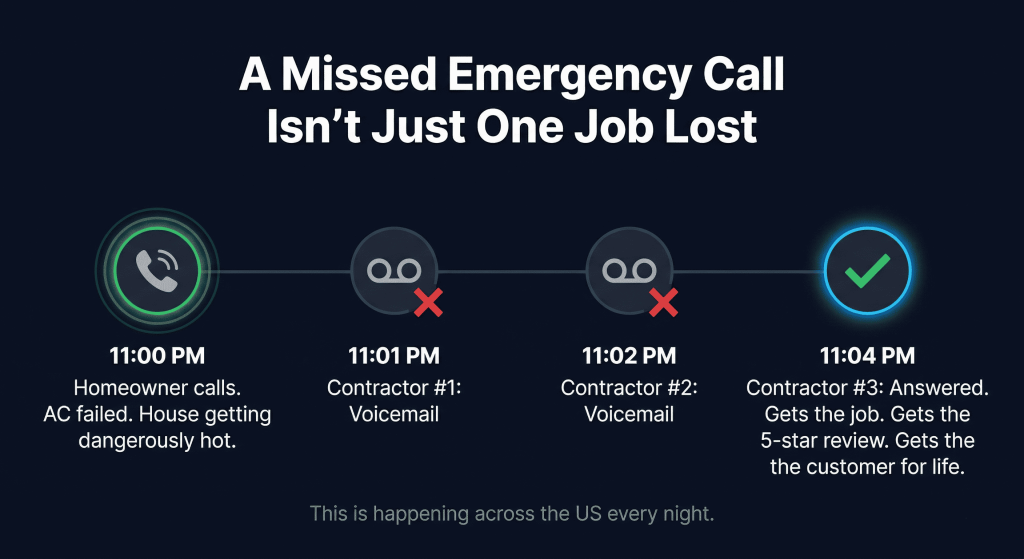
    They call the first contractor they find — usually whoever is at the top of their Google search, or the number saved from a previous service. If that call goes to voicemail, they don’t leave a message and wait. They immediately call the next number on the list. If that goes to voicemail too, they call a third.

    The contractor who answers — whoever it is, at whatever price — gets the job. The other two never find out they lost it.

    This is the single most important thing to understand about HVAC emergency calls: the market for an emergency job closes in minutes, not hours. A homeowner in a genuine emergency will not wait until morning for a callback. By the time you return a voicemail left at 11pm, they are already booked with someone else and their problem is being solved.

    The missed call didn’t just cost you a service call. It gave a competitor a new customer.

    The direct job value

    A single HVAC emergency call represents real money. Depending on the issue and market, emergency service calls typically run $200–$600 for diagnostic and repair work. System replacements triggered by an emergency visit run $5,000–$15,000. Emergency pricing — which most contractors apply for after-hours calls — adds a 1.5x to 2x premium on top of standard rates.

    In Phoenix during a July heatwave, an after-hours emergency call to repair or replace a failed AC unit is one of the highest-value interactions in HVAC. A customer who is panicking about their family’s comfort will not haggle over an after-hours premium. They want the problem solved.

    That’s the job you lose when the call goes unanswered.

    The lifetime value calculation

    The direct job is only part of the picture. The harder number to see — but the more important one — is the lifetime value of the customer you didn’t acquire.

    An HVAC customer who has a great emergency experience typically stays with that contractor for years. Annual maintenance plans, seasonal tune-ups, system upgrades, referrals to neighbours and family. The lifetime value of an HVAC customer over five years is often $2,000–$5,000, depending on the household and market.

    When your competitor answers that 11pm emergency call and does an excellent job, they don’t just get the $400 service fee. They get the maintenance plan renewal next spring, the replacement quote when the system ages out, and the referral to the homeowner’s brother-in-law who mentions his AC has been making a strange noise.

    You got nothing. Because the call went to voicemail.

    Why emergency calls cluster at the worst moments for phone coverage

    The frustrating reality of HVAC emergency calls is that they arrive precisely when your phone coverage is thinnest.

    HVAC systems fail when they’re under maximum stress — during the first extreme heat of summer, during a January cold snap, during an unusual weather event. These are the same periods when your technicians are already stretched across maximum demand, when your dispatcher is handling a surge of routine calls, when everyone is too busy to answer the next incoming call.

    Evening and overnight is when it’s worst. A system that has been struggling all day often fails completely around 6–9pm when the household load peaks. A family that has been tolerating a barely-functioning AC on a 105-degree day reaches crisis point after dinner when it gives out completely.

    That 7pm call on a Friday during a Phoenix heatwave is both your most valuable emergency opportunity and the call most likely to hit voicemail.

    The reputational cost that doesn’t show on any spreadsheet

    There’s a third cost to missed emergency calls that contractors almost never quantify — the review they don’t get, or worse, the one they do get.

    A homeowner who calls in a panic, gets voicemail, calls two more contractors, eventually gets someone to come at midnight, and solves the crisis — occasionally, they come back to the first contractor who didn’t answer and leave a review. Not a good one. “Called at 9pm when our AC died, went to voicemail. Had to find someone else. Very disappointing.”

    That review sits on your Google listing. Every future customer who finds you during an emergency search sees it. The review doesn’t just record a lost job — it actively damages your ability to win the next one.

    Conversely, the contractor who answers that call earns something money can’t easily replicate: a panicked family gets taken care of, and they tell people about it. “Our AC died at 10pm on the hottest day of the year. These guys answered immediately, sent someone within an hour, and had us back up by midnight. Five stars.” That’s the review that drives the next three calls.

    What the fix looks like in practice

    The solution to missed emergency calls isn’t hiring overnight staff. For most small HVAC shops, that’s economically unworkable — you’d be paying a full salary for coverage during hours that generate a fraction of your call volume.

    The practical fix is a system that answers every call regardless of time, identifies emergencies in real time, and notifies your on-call tech immediately for situations that can’t wait until morning.

    Thermoi’s AI assistant Sarah does exactly this. When a homeowner calls at 11pm, Sarah answers within two rings. She asks what’s happening, listens for emergency signals — “no AC,” “no heat,” mentions of vulnerable household members, calls during extreme weather — and responds differently based on what she hears. A routine booking request goes into the appointment queue. An emergency triggers an immediate notification to your on-call tech with the homeowner’s address, contact number, and a summary of the situation.

    The homeowner gets told that a technician has been notified and will be in touch shortly. They don’t get voicemail. They don’t get “please call back during business hours.” They get taken care of.

    That’s the difference between losing a $400 emergency job and a five-year customer relationship, versus capturing both.

    A simple test

    Think about the last three HVAC emergencies in your market — not yours specifically, but the ones happening right now in Phoenix on a hot evening, or anywhere else you serve. Three families with failed AC units, calling contractors.

    How many of those calls are you answering? How many are going to voicemail? How many are ending up with a competitor who happened to pick up?

    If you don’t know the answer to those questions with confidence, that’s the problem. And the $50 two-week pilot is the fastest way to find out.

  • HVAC Appointment Scheduling Software: What Contractors Actually Need in 2026

    If you’ve searched for HVAC appointment scheduling software recently, you’ve probably found two things: enterprise platforms that cost $300–$500 per seat per month and are built for companies with 50+ technicians, and generic scheduling tools that work fine for a yoga studio but have no idea what an emergency dispatch workflow looks like.

    Neither of those solves the actual problem most HVAC contractors have.

    This post breaks down what scheduling software actually needs to do for an HVAC business, what the real options are in 2026, and where AI fits into the picture.

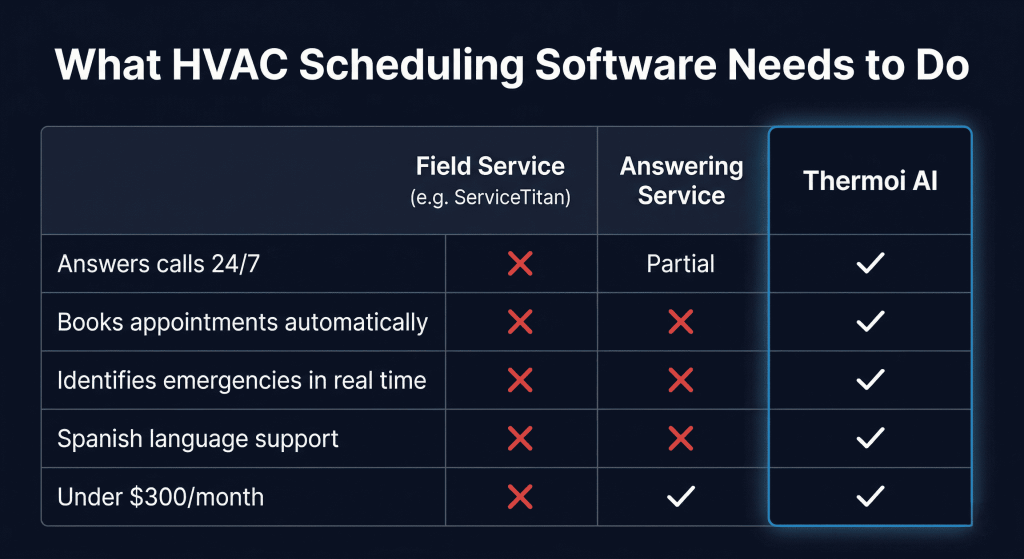
    HVAC scheduling software comparison — ServiceTitan vs Housecall Pro vs Thermoi AI

    What makes HVAC scheduling different from other industries

    Scheduling for HVAC isn’t just putting appointments on a calendar. It involves a set of constraints and scenarios that generic scheduling tools weren’t designed for.

    Emergency vs. routine calls need completely different workflows. A homeowner booking a spring AC tune-up can be scheduled three weeks out with a standard calendar slot. A homeowner whose heat has stopped working in January cannot wait three weeks — or three hours. Any scheduling system for HVAC needs to handle both scenarios, and handle them differently. The emergency caller needs immediate notification to an on-call tech. The routine caller needs a convenient slot in the next available window.

    After-hours is when it matters most. HVAC emergencies don’t wait for business hours. The highest-value calls — system failures, no heat, no AC during extreme weather — come in disproportionately in the evenings, on weekends, and during weather events. A scheduling system that only works when someone is in the office is only solving half the problem.

    Multiple job types need different time allocations. A diagnostic visit might take one hour. An AC system replacement might take six. A routine maintenance check might take 45 minutes. Unlike a business that schedules identical appointments, HVAC contractors need scheduling logic that accounts for job type, travel time between jobs, and technician skill level.

    The person booking isn’t always the decision maker. Tenants call for rental properties. Office managers call for commercial accounts. Spouses call for each other. The scheduling system needs to capture the right contact and site information without assuming every caller is the property owner.

    The three categories of scheduling software HVAC contractors use

    1. Field service management platforms (ServiceTitan, Housecall Pro, Jobber)

    These are the comprehensive, all-in-one platforms built specifically for trades businesses. They handle scheduling, dispatch, invoicing, payments, customer history, and reporting in a single system.

    ServiceTitan is the market leader — used by large HVAC companies and officially partnered with major brands like Carrier and Lennox. It’s genuinely powerful. It’s also priced for larger operations, typically running $125–$400 per user per month with significant onboarding costs. For a 1–5 tech shop that needs scheduling software, it’s often overkill and the learning curve is steep.

    Housecall Pro and Jobber are more accessible — priced at $49–$249 per month depending on the plan — and are genuinely good tools for small and mid-size HVAC shops that want scheduling, invoicing, and basic dispatch in one place. If you’re currently managing jobs on a whiteboard or in Google Sheets, either of these is a significant upgrade.

    The limitation: all of these platforms assume someone is present to receive the call, book the appointment, and enter it into the system. They solve dispatch and job management well. They don’t solve what happens when nobody picks up the phone.

    2. General scheduling tools (Calendly, Cal.com, Acuity)

    These are simple online booking tools that let customers self-schedule appointments from a calendar link. They work well for businesses with predictable, identical appointment types — consultants, therapists, tutors.

    For HVAC, they’re a partial solution at best. A homeowner with a broken AC at 9pm doesn’t want to visit a booking page and pick a time slot. They want to talk to someone. Self-scheduling tools also can’t identify emergencies, capture technical details about equipment, or adjust available times based on technician location and job load.

    Some HVAC contractors use Calendly as a demo booking tool or for non-urgent maintenance requests, which is a reasonable use case. For primary call handling, it’s not the right tool.

    3. AI phone assistants with built-in scheduling

    This is the newest category and the one most directly addressing the gap the other two leave open — after-hours call handling with immediate appointment booking.

    An AI phone assistant answers every inbound call regardless of the time, conducts a real conversation to understand what the caller needs, identifies emergencies vs. routine requests, and either books the appointment directly or notifies the on-call tech immediately. The appointment appears in the contractor’s dashboard without anyone having to manually enter it.

    Thermoi’s Sarah does this on every call. A homeowner calls at 10pm, Sarah answers within two rings, identifies whether it’s an emergency or a booking request, captures the address and equipment details, and books the appointment or fires the on-call notification. The contractor wakes up with a full log of every call that came in overnight, with transcripts and booked appointments already in the dashboard.

    The distinction from field service management platforms is that AI phone assistants solve the front-door problem — what happens when the call comes in — rather than the back-office problem of managing jobs once they’re booked. The two aren’t mutually exclusive: many contractors will eventually use both.

    What to look for in HVAC scheduling software specifically

    Whether you’re evaluating a full field service platform or an AI call handling system, these are the capabilities that matter for HVAC specifically:

    Emergency identification and routing. The system needs to distinguish a no-heat emergency from a routine booking request, and respond differently to each. If it can’t make that distinction, it’s not designed for HVAC.

    After-hours capability. Any gap in coverage is a gap in revenue. The system should handle calls and booking at 2am with the same reliability as 10am.

    Calendar integration. Booked appointments should appear in whatever calendar or dispatch system you already use — Google Calendar, iCal, or a field service platform — without manual data entry.

    Call records and transcripts. Every interaction should produce a written record. This matters for quality control, dispute resolution, and understanding your call patterns over time.

    Spanish-language support. In Phoenix and across the southwest, a significant portion of homeowner calls come in Spanish. A scheduling system that can’t serve those callers is leaving business on the table.

    Realistic pricing for small shops. A 2-tech HVAC operation doesn’t need enterprise software at $300/seat/month. The sweet spot for small shops is $50–$300/month for software that solves a specific problem well.

    The gap most HVAC scheduling software doesn’t address

    Here’s the honest summary of where the market stands in 2026: the field service platforms (ServiceTitan, Housecall Pro, Jobber) are excellent at managing jobs that are already in the system. They’re not designed to handle the moment when a call comes in and nobody is available to answer it.

    That gap — after-hours calls, busy-period overflow, the Friday night emergency — is where HVAC businesses lose the most revenue. It’s also where AI phone assistants are specifically designed to help.

    The right setup for most small HVAC shops isn’t one tool that does everything. It’s a combination: a lightweight field service tool for job management and invoicing, and an AI phone assistant to make sure every call that comes in gets answered and booked, regardless of the time.

    For contractors not yet using any scheduling software — still managing jobs on a whiteboard or personal cell — the highest-ROI starting point is almost always solving the missed call problem first. A booked appointment you never knew about is worth nothing. A call answered and booked automatically at 11pm on a Saturday is worth $400–$700 before you even wake up.

    Thermoi’s approach

    Thermoi focuses specifically on the call handling and appointment booking layer — the front door of your HVAC operation. Sarah answers every call 24/7, identifies emergencies, books routine appointments automatically, and notifies your on-call tech immediately when something can’t wait until morning.

    The pilot is $50 for two weeks. Most contractors see the first after-hours booking within the first few days.

  • How Missed HVAC Calls Are Costing Your Business More Than You Think

    Most HVAC contractors know they’re missing calls. What they don’t know is the number.

    Not the vague sense that some calls slip through during busy periods — the actual dollar figure attached to the calls that rang out, hit voicemail, or came in at 10pm on a Friday when nobody was available to answer. That number, when contractors calculate it honestly for the first time, is almost always larger than they expected.

    This post walks through how to calculate it for your business specifically — and what the realistic options are for reducing it.

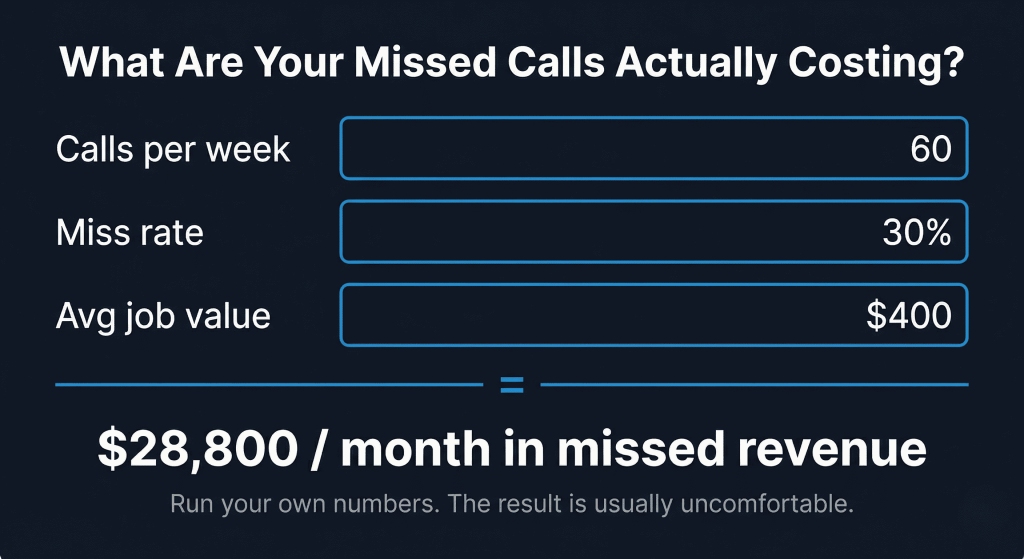
    Calculator showing the real cost of missed HVAC calls — revenue loss by week

    Why missed calls are an HVAC-specific problem

    In most industries, a missed call is an inconvenience. In HVAC, it’s a lost job.

    Here’s why: when a homeowner’s air conditioning fails on a 100-degree July afternoon in Phoenix, they don’t send one enquiry and wait patiently. They call three contractors in a row and book with the first one who answers. The contractors who didn’t answer never find out they lost the job. There’s no follow-up, no voicemail callback, no second chance. The customer is already booked with someone else.

    This winner-takes-all dynamic means missed calls in HVAC carry a cost that doesn’t exist in most other service businesses. The call doesn’t go into a queue to be answered later. It walks straight to your nearest competitor.

    The problem is worst at exactly the moments when call volume is highest — peak summer and winter weather, evenings and weekends, and any period when all your techs are simultaneously on jobs. These are the highest-value calls (emergency jobs, system replacements) arriving at the exact moments your phone handling is at its weakest.

    How to calculate what missed calls are costing your business

    Rather than using industry averages — which vary wildly depending on business size, market, and service mix — the most useful thing is to calculate your own number.

    Here’s a simple framework:

    Step 1 — Estimate your weekly call volume. If you have a phone system with call logs, pull the last 30 days. If not, think about how many calls you personally receive on your cell on a typical weekday, then factor in evenings and weekends. A small HVAC shop serving a single market typically receives between 30 and 100 calls per week depending on season.

    Step 2 — Estimate your miss rate. This is the hard one to be honest about. Count only calls answered live — not returned voicemails, not next-day callbacks. If you have two techs out on jobs from 8am to 5pm and nobody in the office, your miss rate during those hours is effectively 100%. Most small shops, when they add up evenings, weekends, and busy daytime periods, find their real miss rate is somewhere between 25% and 50% of total weekly call volume.

    Step 3 — Apply your average job value. For a service call, this might be $200–$400. For a system replacement lead, it could be $5,000–$15,000. If you handle a mix, use a blended average. A reasonable middle figure for a general HVAC service call is $350–$500.

    Step 4 — Multiply. Weekly missed calls × average job value × 4 weeks = monthly missed revenue.

    A shop receiving 60 calls per week with a 30% miss rate (18 missed calls/week) and an average job value of $400 is missing roughly $28,800 per month in potential revenue. That’s not a worst-case scenario — it’s a conservative estimate for a mid-size single-market operation.

    Run your own numbers. The result is usually uncomfortable the first time you see it.

    Where the missed calls actually come from

    Understanding the pattern matters because not all missed calls are equal — and the most expensive ones tend to cluster in specific windows.

    After-hours and weekends. The majority of HVAC emergencies happen outside business hours. An AC that’s been struggling all day often fails completely at 6pm when the homeowner gets home. A heating system failure in January rarely announces itself at 10am on a Tuesday. If your phone coverage ends at 5pm, you’re unprotected during the highest-urgency call window.

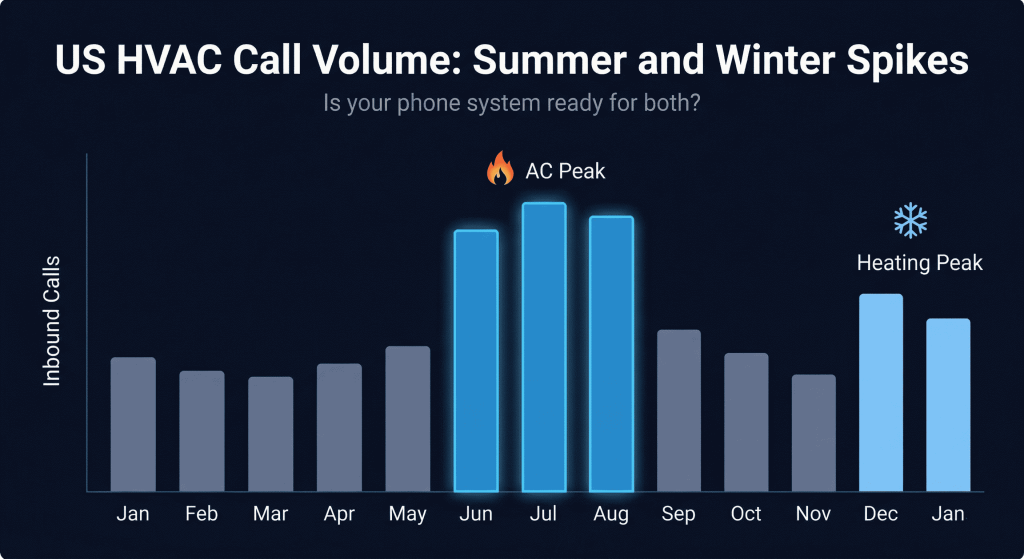
    Peak season surges. During the first heat wave of summer or the first cold snap of winter, call volume can double or triple within a 48-hour period. Your call handling capacity doesn’t scale with demand. The overflow goes unanswered.

    Simultaneous call conflicts. Small shops often operate with one person handling calls — the owner, an office manager, or whoever isn’t currently on a job. When that person is already on a call, on a job, or at lunch, every subsequent call that arrives goes to voicemail. These conflicts are invisible until you look at your call logs carefully.

    Spanish-language callers. In Phoenix and across much of the southwest, a meaningful segment of the homeowner market calls primarily in Spanish. If your current call handling can’t serve these callers confidently, you’re leaving a portion of your potential market entirely unserved.

    What the options actually cost

    There are three main approaches contractors use to address missed calls, each with real trade-offs.

    Hiring a receptionist or office manager typically costs $35,000–$50,000 per year in salary and benefits for a full-time employee, and covers business hours only. Evenings, weekends, and peak surges remain uncovered unless you pay overtime or add a second hire.

    A traditional answering service costs $100–$400 per month and provides 24/7 human coverage. The limitation is that generic answering service operators don’t understand HVAC — they take a message and promise someone will call back. For routine calls this works. For emergencies, the delay between the homeowner’s call and your on-call tech’s notification can run 30–60 minutes. In a competitive market, that delay costs you the job.

    An AI phone system like Thermoi costs $299 per month and answers every call immediately, 24/7. It handles routine booking and appointment scheduling automatically, and for emergency calls it notifies your on-call tech within seconds rather than routing through a message relay. It produces a full transcript of every call, so you can review any interaction and see exactly what was said.

    The break-even calculation is straightforward: if the system captures one additional service call per week that would otherwise have gone to voicemail, at an average job value of $400, it pays for itself several times over at $299/month.

    The call you can’t afford to miss

    Not all missed calls cost the same. A missed routine maintenance enquiry might eventually call back. A homeowner whose AC has failed at 9pm on a Friday — with children or elderly parents in the house during a summer heat wave — will not wait. They need someone now. The contractor who answers gets a high-urgency job, a grateful customer, and very likely a five-star review. The contractors who didn’t answer never knew the opportunity existed.

    Those are the calls worth protecting. They’re also the ones most likely to arrive at the exact moments your current phone coverage is thinnest.

    The $299 pilot runs for two weeks at $50. If Sarah handles one emergency call during that period that would otherwise have hit voicemail, the pilot more than pays for itself — and you have a clear picture of what the full system looks like in practice.

  • The Complete Guide to AI Phone Systems for HVAC Contractors


    If you run an HVAC business, you’ve probably noticed more tools showing up that promise to “use AI” to fix your operations. Some of them are genuinely useful. A lot of them aren’t built for the way HVAC businesses actually work.

    This guide covers what AI phone systems are, how they work in the context of an HVAC business specifically, what to look for when evaluating one, and where the real ROI comes from. No hype — just a practical breakdown from the contractor’s perspective.

    What an AI phone system actually is

    An AI phone system is software that answers inbound calls on your behalf, conducts a real conversation with the caller, and takes a defined action at the end — booking an appointment, flagging an emergency, sending a transcript, or routing to a human.

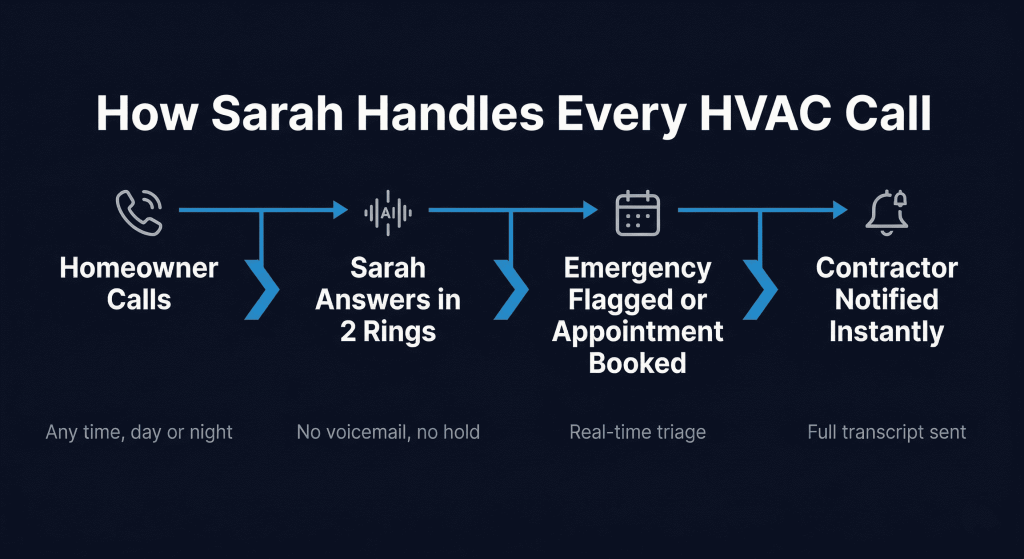
    How an AI phone system works for HVAC contractors — Sarah handles inbound calls 24/7

    It’s not a voicemail system. It’s not a pre-recorded message tree. When a homeowner calls and says “my AC just stopped working and it’s 95 degrees in here,” a well-built AI phone system understands that sentence, recognises the urgency, asks the right follow-up questions, and responds appropriately — either booking an emergency appointment or notifying your on-call tech immediately.

    The underlying technology is voice AI — the same category of technology powering tools like Siri, Alexa, and more recently, a generation of purpose-built business phone assistants. What makes modern voice AI meaningfully better than older systems is that it handles natural, unscripted conversation. Callers don’t have to press 1 for this and 2 for that. They just talk.

    Why HVAC is a particularly good fit for AI phone systems

    Not every business benefits equally from AI phone systems. HVAC does, for several specific reasons.

    Call timing is unpredictable and urgent. Unlike a dentist’s office where appointments are scheduled weeks in advance, HVAC emergencies happen without warning — and they happen disproportionately at inconvenient times. A heat pump failure in January doesn’t wait for business hours. An AC breakdown in a Phoenix summer hits at 7pm on a Friday. These are the calls most likely to hit voicemail, and they’re the calls with the highest urgency and highest job value.

    The first-to-answer wins. When a homeowner’s HVAC system fails, they don’t send one enquiry and wait. They call three contractors in a row and book with whoever picks up. The competitive dynamic in HVAC is immediate and winner-takes-all on each call. A contractor who answers 90% of calls captures jobs that their competitors never even know they lost.

    There’s a clear, measurable ROI. A typical HVAC service call runs $200–$700. A system replacement is $5,000–$15,000. If an AI phone system captures two additional calls per week that would otherwise have gone to voicemail, the ROI is obvious and calculable — usually well under two months to break even at $299/month.

    Emergency and routine calls need different handling. This is the nuance that generic AI call systems miss. A homeowner asking about a spring tune-up can wait until morning. A homeowner with no AC and a baby in the house cannot. HVAC specifically requires a system that can distinguish between these two scenarios and respond differently — routing emergencies to the on-call tech immediately rather than adding them to tomorrow’s queue.

    How an AI phone system works on a real HVAC call

    Here’s what happens on a typical inbound call handled by Thermoi’s AI assistant, Sarah.

    A homeowner calls at 9:47pm. Their upstairs AC unit stopped blowing cold air three hours ago. Sarah answers within two rings. She introduces herself as calling on behalf of the HVAC company, asks what the issue is, and listens. The homeowner explains the problem. Sarah asks a few follow-up questions — how long it’s been down, whether it’s making any unusual sounds, whether anyone in the house has medical needs that make heat particularly dangerous.

    Based on those answers, Sarah determines this is an urgent situation. She doesn’t offer a next-day appointment. She tells the homeowner that she’s going to notify the on-call technician immediately and that someone will be in touch within the hour. She captures the address, confirms the contact number, and sends a full transcript to the contractor’s dashboard.

    The on-call tech gets an SMS notification within 30 seconds. The contractor’s dashboard shows the full call record with the AI’s summary of the situation.

    That’s one call that would have hit voicemail without a system like this. Depending on the urgency, that’s a $300–$500 service call or the beginning of a system replacement conversation.

    What to look for when evaluating an AI phone system for HVAC

    Not all AI phone systems are built the same. Here’s what matters specifically for HVAC:

    Emergency detection. The system needs to identify emergency signals in real conversation — “no heat,” “no AC,” mentions of vulnerable household members, late-night calls during extreme weather — and handle those calls differently from routine ones. If the system treats every call the same way, it’s not designed for HVAC.

    Natural conversation handling. Homeowners don’t speak in structured sentences. They ramble, backtrack, and describe problems in non-technical terms. The AI needs to extract the relevant information without making them feel like they’re filling in a form. If the system requires callers to respond in specific phrases, it will frustrate people and hurt your reputation.

    Appointment booking integration. Capturing information is only half the job. The system should book the appointment directly into your calendar — not just send you a message saying someone called. Thermoi’s Sarah books appointments that appear immediately in the dashboard, complete with customer details and the AI’s summary of the call.

    Full call transcripts. Every call should produce a written record. This matters for two reasons: first, you can review any call where something went wrong and understand exactly what happened. Second, the transcript data builds up over time into a picture of your most common call types, objections, and customer pain points.

    Bilingual capability. In Phoenix and across much of the US southwest, Spanish-speaking callers represent a significant portion of the market. An AI system that can handle Spanish-language calls without switching to a different mode or failing mid-conversation is a meaningful advantage.

    White-label capability. The best systems answer as your company, not as a generic AI service. When Sarah answers a call for Smith’s Heating and Cooling, she introduces herself as being with Smith’s Heating and Cooling. Callers don’t know they’re talking to an AI unless they ask.

    What AI phone systems don’t do (yet)

    Being clear about limitations matters.

    Current AI phone systems are designed for inbound call handling — answering calls, gathering information, booking appointments, and routing emergencies. They’re not yet capable of handling complex diagnostic conversations (a homeowner trying to troubleshoot a problem live), nuanced negotiation (a customer pushing back hard on pricing), or situations that require genuine human judgment about ambiguous circumstances.

    The right way to think about them is as a highly capable first point of contact. They handle the structured part of the call — capturing information, qualifying urgency, booking the appointment — and hand off anything that needs a human to a human.

    For most HVAC contractors, this covers 80–90% of inbound calls entirely, and gives the remaining 10–20% a much better first experience than voicemail.

    The setup process

    One of the common objections to AI phone systems is complexity — contractors assume integration will take weeks and require an IT person.

    For Thermoi, the setup process is straightforward. You provide your business information, emergency dispatch preferences, and on-call schedule. Sarah is configured to represent your company specifically — your name, your service area, your procedures for handling emergencies versus routine bookings. Most contractors are live within a day or two.

    The two-week pilot at $50 is designed to let you see the system working on real calls before committing to the full $299/month. If Sarah handles even two calls during the pilot that would otherwise have gone to voicemail, the pilot pays for itself.

    The question worth asking yourself

    Before spending more on ads, hiring a part-time receptionist, or upgrading your answering service, it’s worth asking a simpler question: what percentage of calls that come into your business right now are actually being answered?

    If the honest answer is anything below 85–90% — accounting for evenings, weekends, busy periods when all your techs are on jobs — then an AI phone system is the highest-ROI investment available to you. It doesn’t generate new leads. It captures the leads you’re already paying for but currently losing.

    That’s the real value of a voice AI for HVAC. Not magic. Just never missing a call again.

  • 5 Ways HVAC Contractors Can Prepare for Peak Season Call Volume

    Every HVAC contractor knows the feeling. It’s the first week of June in Phoenix. The temperature hits 108°F. Your phone starts ringing at 7am and doesn’t stop. Three techs are already on jobs. You’re driving to a fourth. And somewhere in that chaos, calls are going to voicemail.

    US HVAC call volume summer and winter spikes — peak season preparation

    That’s peak season. And for most small HVAC shops, it’s both the best and worst time of year — the most revenue opportunity and the most revenue lost simultaneously.

    The contractors who win peak season aren’t just the ones who work hardest. They’re the ones who prepared before it started.

    Here are five things worth doing now, before the rush hits.

    1. Find out how many calls you’re actually missing

    Most HVAC contractors have no idea what their real call answer rate is. They know they’re busy. They know some calls go to voicemail. But they don’t know the number.

    Before peak season, spend one week tracking every incoming call. Note which ones were answered live, which went to voicemail, and which rang out with no answer at all. If you have a phone system with call logs, pull the data. If you’re on a personal cell, go through your missed calls for the last 30 days.

    What you’ll likely find is uncomfortable. Contractors who do this exercise for the first time regularly discover they’re missing 20–40% of their calls during normal operating hours — and a much higher percentage after 6pm and on weekends. During peak season when call volume spikes, that miss rate tends to climb.

    You can’t fix what you haven’t measured. Start here.

    2. Separate emergencies from routine calls before they hit your dispatch

    This is the step most HVAC businesses skip entirely — and it costs them the most during peak season.

    When a family’s AC stops working at 9pm in July, they are not calling to schedule a tune-up. They are calling in a panic. They need to know someone is coming. If they get voicemail, they immediately call the next contractor on their list. If they get a human — or an AI that correctly identifies their situation as an emergency — they stay with you.

    The problem is that during peak season, your dispatcher or answering service is handling every call the same way. Routine service requests, maintenance plan reminders, new customer enquiries, and genuine emergencies all go into the same queue. The emergency family calling at 9pm waits behind the customer asking about a tune-up price.

    The fix is a triage system — whether human or AI — that identifies emergency signals in real time. “No AC in Phoenix in July,” mentions of elderly or young children in the home, calls after 8pm during a heatwave. These are signals that should trigger an immediate on-call tech notification, not a next-morning callback.

    Thermoi’s AI (Sarah) does this on every inbound call. She listens for emergency signals and routes them differently from routine requests — the on-call tech gets notified immediately rather than the homeowner getting added to tomorrow’s queue. That one distinction captures jobs that would otherwise go to the first competitor who answers.

    3. Pre-schedule your maintenance plan customers before peak season starts

    If you run a Comfort Club or any form of maintenance agreement, peak season is the wrong time to be scheduling those visits. Your techs are already slammed. Adding maintenance appointments on top of emergency dispatch during a heat wave creates delays, rushed work, and unhappy customers.

    The solution is to front-load your maintenance schedule. Starting in April or early May, reach out to all maintenance plan customers and get their summer tune-ups on the calendar before temperatures spike. Offer a small incentive for early scheduling — a filter replacement, a priority service window, a modest discount.

    This does two things. First, it reduces the call volume hitting your dispatch during peak weeks because a chunk of your customers are already handled. Second, it gives you cleaner intel on which systems are likely to fail during the summer — you can flag the ones in poor condition during the pre-season tune-up and have that conversation with the homeowner before they become an emergency call at midnight.

    Maintenance plan customers who get a pre-season call feel cared for. Those who have to chase you for their annual service feel like an afterthought. The difference shows up in your renewal rates.

    4. Audit your on-call rotation before you need it

    Here’s a peak season scenario that plays out at HVAC shops every summer: an emergency call comes in at 10pm, the answering service takes the message, the on-call tech gets the message at 10:30pm, calls the customer back at 10:45pm, and discovers the customer already hired someone else at 10:15pm.

    That 45-minute window is the gap that kills after-hours revenue.

    Before peak season, review your entire on-call process end to end. How does an after-hours emergency call reach your on-call tech? How many steps are in the chain? How long does each step take? Where are the handoff failures?

    The benchmark to aim for is under 10 minutes from call to on-call tech notification. If your current process takes longer — and most do — map the steps and find the delays. Common fixes include direct SMS alerts rather than message relay through an answering service, a dedicated on-call line that bypasses the main number, and a backup tech who automatically gets notified if the primary doesn’t respond within five minutes.

    The Air-Rite approach — which came up during a real Thermoi demo — was to have on-call techs paged before 10pm and called directly after. That’s the right instinct. The gap is that the handoff still goes through a human chain. An AI layer that handles the initial call and fires the notification immediately removes that chain entirely.

    5. Set customer expectations clearly — before and during the call

    During peak season, even the best HVAC operations run behind. That’s not a failure — it’s physics. You have a fixed number of techs and more demand than capacity.

    What determines whether a delayed customer leaves a bad review or a patient one is almost entirely about expectation setting. A customer who is told at 9pm “we have availability tomorrow morning between 8 and 11, I’m booking you right now” is far less frustrated than a customer who gets “someone will call you back” and then waits without hearing anything.

    Two things to implement before peak season:

    First, give your call handlers (human or AI) specific language for communicating wait times honestly. “We’re extremely busy this week — the earliest I can get someone to you is Thursday morning. Would you like me to book that?” is better than vague reassurances. Customers respect honesty. They don’t respect being strung along.

    Second, send automated confirmation and reminder messages for every booked appointment. An appointment reminder the morning of the visit, with the technician’s name and a rough arrival window, reduces no-access jobs and makes you look organised even when you’re stretched thin.

    Sarah sends these automatically for every appointment she books. The homeowner gets a confirmation within minutes of hanging up. By the time your tech arrives, the customer has been touched three times and knows exactly what to expect. That’s the experience that generates five-star reviews even during the busiest weeks of the year.

    The prep that pays off most

    Of the five items above, the one with the highest return is fixing your emergency triage and on-call notification speed. Routine calls can wait. Emergency calls cannot. Every minute between a homeowner’s AC failure and your on-call tech’s notification is a minute during which they’re calling your competitors.

    Peak season is when HVAC businesses are made or broken. The contractors who do the prep work in April and May — auditing their call handling, front-loading maintenance schedules, tightening their on-call chain — capture the summer revenue that funds everything else. The ones who wait until June to think about it spend the whole season scrambling.

    Start now. Peak season in Phoenix is already on its way.

  • Why HVAC Customer Experience Starts the Moment the Phone Rings

    It’s 9pm on a Friday in July. A homeowner’s AC just stopped working in Phoenix. The temperature inside is already 85°F and climbing. They have two kids and an elderly parent in the house.

    HVAC contractor answering emergency phone call at night — Thermoi AI phone system

    They pick up their phone and search “HVAC emergency repair Phoenix.” They find three contractors with decent Google ratings. They call the first one.

    Voicemail.

    They call the second one.

    Voicemail.

    They call the third one — and someone answers.

    That third contractor just won a $400–700 emergency job. Not because of their price, not because of their reviews, not because of their truck wraps. Because they answered.

    This is where HVAC customer experience actually starts — not when the technician shows up, not when the invoice is sent, but the moment the phone rings.

    The Missed Call Is the Missed Moment

    Most HVAC contractors think about customer experience in terms of job quality, technician professionalism, and pricing. Those things matter enormously — but they only come into play if the customer reaches you first.

    The research tells a painful story:

    A typical small HVAC shop misses 5 to 15 calls per week. At an average job value of $400 to $700, that’s $2,000 to $10,000 in potential revenue walking out the door every single week. Most of it goes to whoever picks up the phone.

    After-hours and weekends are when it hurts most. That’s exactly when emergencies happen — when a family’s heat goes out on a December night, when an AC fails in the middle of a Phoenix heatwave. Those are high-urgency, high-value calls. And they’re the ones most likely to hit voicemail.

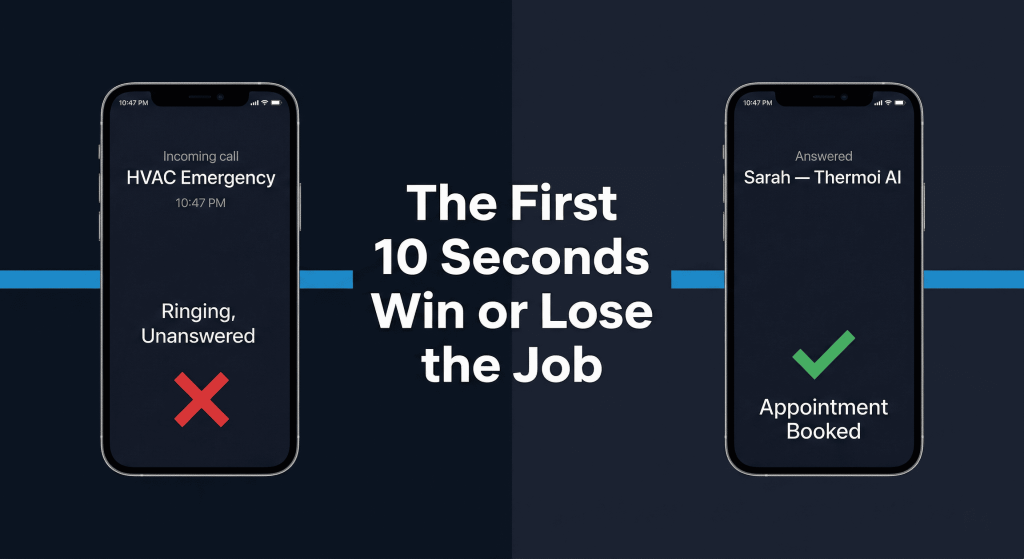
    The first 10 seconds of a call shapes everything that follows: whether they book with you or your competitor, how professional they think you are, whether they ever call you again.

    What Happens Inside an HVAC Emergency Call

    To understand why phone experience matters so much in HVAC specifically, it helps to understand what a homeowner is actually feeling when they call.

    They’re not comparison shopping. They’re stressed. Their comfort system has failed — often at the worst possible time — and they need someone to take control of the situation. What they want to hear in the first 30 seconds is:

    • Someone answered
    • They understand the problem
    • They know what to do about it
    • Help is coming

    What they don’t want is to leave a message, wait for a callback that may never come, or repeat their address and problem to three different people.

    The Air-Rite demo — a real call session run through Thermoi’s AI — showed this in practice. A homeowner calls at 10pm reporting a complete AC failure. The AI answers immediately, asks the right questions (address, equipment type, is it a total failure or partial), and — critically — identifies it as an emergency rather than defaulting to a next-morning appointment. It tells the homeowner that an on-call technician will be notified immediately. The homeowner’s stress level drops. They feel taken care of.

    That’s customer experience. Not a form to fill in, not a callback promise — immediate, intelligent response.

    The Emergency Dispatch Gap Most Contractors Don’t Know They Have

    Here’s something most HVAC software and answering services get wrong: they treat every call the same.

    A customer calling to schedule a routine spring AC tune-up should go into the booking queue. A customer calling at 11pm because their elderly mother’s heat has stopped working should trigger an immediate notification to your on-call technician.

    These are not the same situation. But most answering services and basic AI tools handle them identically — they collect information and schedule a callback or next-day appointment.

    The distinction matters enormously to your customers. A homeowner in a genuine emergency who gets told “someone will call you back in the morning” does not feel cared for. They feel abandoned. They hang up and call the next contractor.

    The right phone system — whether human or AI — needs to be able to make this distinction in real time. Emergency signals include: “no heat,” “no AC,” specific mentions of vulnerable household members, or calls after 9pm during extreme weather. When those signals appear, the response changes. The on-call tech gets notified directly. The homeowner gets a realistic timeline.

    That decision — made in the first 60 seconds of a call — determines whether that customer books with you, leaves you a 5-star review, and refers their neighbour.

    Why Consistency Beats Heroics

    The best HVAC contractors build reputations on reliability — not occasional excellence but consistent, predictable quality every single time a customer calls.

    Human answering has inherent inconsistency. Your dispatcher is excellent on a Tuesday morning and overwhelmed on a Saturday afternoon during peak season. Your on-call tech answers professionally most of the time but occasionally sounds half-asleep at 2am. These are human realities. They’re understandable. But they create variance in the customer experience that damages your brand in ways you often don’t see until a review appears.

    AI phone systems like Thermoi’s Sarah don’t have bad days. The 2am call gets the same professional, unhurried, knowledgeable response as the 10am call. During peak season when your call volume triples, the 15th call of the day sounds exactly like the first.

    Consistency isn’t glamorous. But it’s what builds the kind of reputation that fills your schedule without paid advertising.

    The Metrics That Actually Tell You How Your Phone Experience Is Performing

    Most HVAC contractors have no idea how their phone experience is actually performing. They know their Google rating but not their call answer rate. Here are four numbers worth tracking:

    Answer rate: What percentage of incoming calls are answered live — not by voicemail, not by an answering service that takes a message? For most contractors without an AI system, this is well below 80% when you account for after-hours, peak periods, and times when everyone is on a job.

    Voicemail-to-callback conversion: Of customers who leave a voicemail, how many actually convert to a booked appointment? The data is not encouraging — most don’t wait.

    Emergency identification rate: Of calls that were genuine emergencies, how many were correctly identified and dispatched same-day rather than scheduled next-morning? This is nearly impossible to measure without call transcripts.

    Review correlation: Compare your Google reviews that mention “easy to reach,” “answered right away,” or “quick response” against periods when your call handling was stronger. The correlation is almost always there.

    Thermoi’s dashboard gives HVAC contractors visibility into all of these — every call logged, every transcript available, every appointment created by the AI visible in one place. It’s the operational data most contractors have never had access to before.

    What This Looks Like in Practice

    The shift from “hope someone answers” to “every call handled professionally” is simpler than most contractors expect.

    Thermoi’s AI assistant — Sarah — answers every inbound call 24/7. She introduces herself as calling on behalf of your business, asks what the customer needs, identifies whether it’s an emergency or a routine booking, captures their address and equipment details, and either books the appointment directly or notifies your on-call technician immediately for emergencies. Every call gets a full transcript. Every appointment shows up in the dashboard.

    For contractors already running an answering service, Thermoi isn’t a replacement — it’s a layer of intelligence on top of what you already have. For contractors currently relying on voicemail and callbacks, it’s the difference between capturing those 10pm Friday calls and losing them.

    The pilot is $50 for two weeks. If Sarah handles even one emergency call that would have otherwise gone to voicemail, the pilot pays for itself.

    The Bottom Line

    Customer experience in HVAC doesn’t start when your technician arrives at the door. It starts when the phone rings — at 2pm on a weekday, at 10pm on a Friday, at 6am on a January morning when a family wakes up to no heat.

    The contractors who win on customer experience aren’t just doing better work. They’re answering the phone when others don’t. They’re identifying emergencies correctly. They’re giving homeowners the clarity and confidence they need in a stressful moment.

    That’s what a great phone system delivers. And in a market where the first contractor to answer usually wins the job, it’s not a nice-to-have. It’s the whole game.